- Cookies that enable provisioning of services you require.
- Cookies that inform NIC.LV about your visit on the website www.nic.lv - your consent is necessary for use of these cookies.

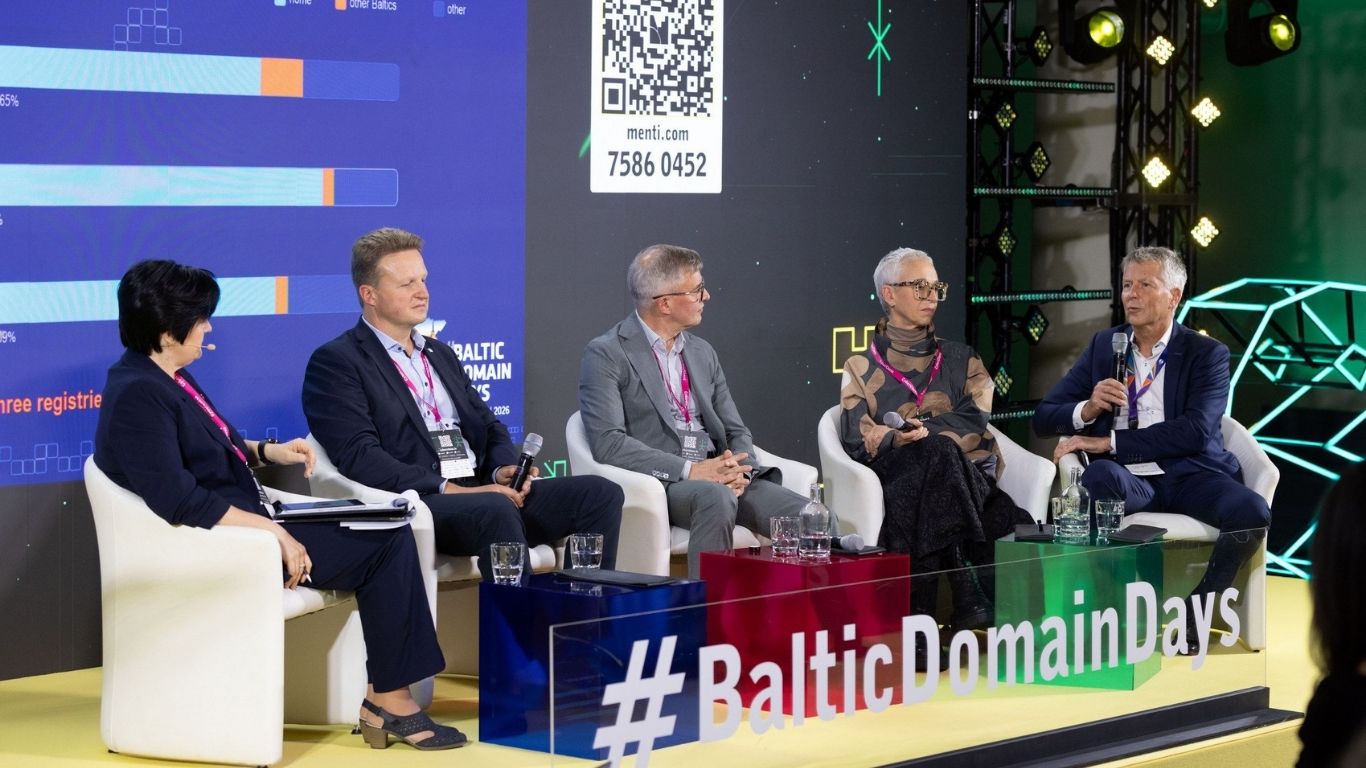
On 14–15 October, Riga hosted the sixth Baltic Domain Days 2026, bringing together domain industry, internet infrastructure and cybersecurity experts from the Baltic states and other countries around the world. This year, the event was held as part of the international cybersecurity conference CyberChess 2026.
Over two days, experts discussed developments in the domain name market, the impact of artificial intelligence, DNS security and resilience, the challenges posed by the NIS2 Directive, registration data verification and the future of the internet.
The central question running through the conference was: how can we ensure a secure, resilient and trustworthy internet at a time when technology, cyber threats and regulatory requirements are constantly evolving?
Katrīna Sataki, Head of NIC.LV, opened the conference with a humorous example of how animal names differ across the Baltic languages, inviting participants to reflect on how well we really understand our neighbours.
The same applies to the domain industry: although the Baltic countries share geography, history and common challenges, each has its own market characteristics and approaches to solving problems.
Patrick Myles (CENTR) presented the latest trends in the European domain market, highlighting a recovery in growth rates following a slowdown in recent years. In September 2026, the median 12-month growth rate for European country-code top-level domains reached 4.7%, approaching the peak seen during the COVID-19 pandemic. According to CENTR (the association of European country-code top-level domain registries), its members’ European ccTLDs collectively account for more than 71 million registered domain names, including approximately 625,000 across the Baltic national domains.
He also highlighted differences between the Baltic markets. For example, Estonia has 11.4 domain names held by domestic registrants per 100 inhabitants, compared with 7.7 in Lithuania and 6.2 in Latvia. Meanwhile, .LV has the highest share of foreign registrants in the Baltics, at 29%. Despite their differences, all three markets are affected by wider industry trends. Artificial intelligence, social media and apps are changing how people discover information, making domain names less visible. At the same time, the rise of AI agents and easier website creation could open up new opportunities for the domain industry.
Moderator: Katrīna Sataki (.LV)
Panelists: Heiki Sibul (.EE), Tomas Mackus (.LT)
Is there a single Baltic domain name market, or are there three separate national markets?
This question opened the first panel discussion, in which representatives of the Latvian, Lithuanian and Estonian registries compared their market characteristics, registrar ecosystems, competitive environments and shared challenges.
Particular attention was paid to the impact of artificial intelligence on domain name registration. Could AI agents eventually choose and register domain names on behalf of people? And would they favour .LV, .EE and .LT, or global domains?
Moderator: Katrīna Sataki (.LV)
Panelists: Heiki Sibul (.EE), Tomas Mackus (.LT), Barbara Povše (Arnes, .SI), Roelof Meijer (SIDN, .NL)
In the second part of the discussion, experts from the Slovenian and Dutch registries joined their Baltic counterparts, broadening the conversation to the European domain industry as a whole.
The panel explored how registries could work more closely together on cybersecurity, technological development and resilience. Could solutions that each registry currently develops independently be created jointly in the future?
The discussion highlighted the value of knowledge sharing and practical cooperation: despite their differences, European registries face many of the same challenges.
On 13 October, Riga hosted the 30th meeting of the CENTR Research & Development (CENTR R&D) working group, bringing together technical experts and researchers from European national domain registries to share their latest research and experience.
Part of the working group’s programme was also included in Baltic Domain Days, bringing developments in domain industry technology to the attention of a wider audience of registrars and decision-makers.
Thymen Wabeke (SIDN, .NL) introduced the work of the CENTR R&D group. Its core purpose is to foster cooperation among European domain registries in research and technological development.
The group focuses on DNSSEC, DNS measurements, data infrastructure, artificial intelligence and abuse detection. Joint research and knowledge sharing help registries tackle complex technical challenges more effectively and reduce costs.
Sebastian Castro (.IE) introduced the OpenINTEL project, which has been systematically collecting and analysing DNS data from around the world since 2015.
The presentation explored trends in domain names, email configuration, IPv6 support, SPF adoption and DNSSEC validation. These long-term measurements help researchers understand the evolution of internet infrastructure, compare technical configurations across domains and identify potential security risks.
Vairis Caune (CERT.LV) examined the use of artificial intelligence in the DNS industry, discussing both its opportunities and the new cybersecurity risks it introduces.
AI is increasingly being integrated into everyday operations, where it processes data and helps automate tasks. However, it also creates new threats, including the risk of sensitive data leaks and unauthorised actions.
At the same time, AI can help detect phishing domain names more quickly, analyse suspicious registrations and assess cybersecurity incidents.
The key takeaway: using AI does not automatically make a system secure. What matters is how the technology is implemented and controlled.
Andriy Khvetkevych (NicNames and NIC.UA) discussed situations in which reports of alleged abuse are weaponised to have legitimate websites taken offline.
Responding too slowly can allow malicious activity to continue, while acting too hastily can harm legitimate businesses.
He demonstrated how AI agents can help analyse reports, verify evidence and prepare recommendations for further action. However, final decisions must remain in the hands of responsible professionals.
Jānis Kārkliņš (ICANN) provided an overview of the global internet governance system and the role of international organisations in its development.
The internet does not belong to any single country or organisation. Its operation relies on cooperation among the technical community, businesses, government institutions and civil society.
The presentation covered the roles of ICANN (Internet Corporation for Assigned Names and Numbers), IANA (Internet Assigned Numbers Authority) and other organisations, as well as growing geopolitical challenges that could threaten the unity of the internet.
A single, globally interoperable internet is the foundation of countries’ digital development, and preserving it requires international cooperation and trust.
Aysegul Tekce (ICANN) presented the 2026 round of the New Generic Top-Level Domains (gTLD) Program.
More than 1,600 applications for new top-level domains were submitted during this round. The presentation explained the programme’s objectives, the application evaluation process and the next steps.
The expansion of the domain name space promotes diversity and competition, while also encouraging national domain registries to consider their position in the global market.
Charlotte Spencer (WIPO) presented trends in domain name dispute resolution and the challenges of protecting intellectual property rights.
As phishing, impersonation and other forms of abuse increase, effective and accessible mechanisms for protecting rights are becoming ever more important.
Particular attention was also paid to Latvia’s experience. Since 1 October 2024, an alternative dispute resolution procedure has been available for .LV domain name disputes, introduced in cooperation with WIPO (The World Intellectual Property Organization). It makes it possible to resolve domain name disputes more quickly and simply, without necessarily going to court.
Moderator: Barbara Povše (Arnes, .SI)
Panelists: Jānis Kārkliņš (ICANN), Charlotte Spencer (WIPO), Iveta Skujiņa (.LV), Helen Aaremäe-Saar (.EE), Tomas Mackus (.LT)
The first day concluded with a discussion on the growing impact of regulation on the domain industry.
Although the internet is global, domain registries must operate within different national and international legal frameworks. How can increasingly strict requirements be balanced with the technical principles that keep the internet running? And where does a domain registry’s responsibility begin and end?
The discussion underscored the need for proportionate, practical regulation, particularly in light of the resources available to smaller registries and registrars.
The second day focused on “A Safer and More Resilient Baltic Domain Space”, a session covering DNS infrastructure resilience, NIS2 requirements, registration data verification and the importance of trust in the digital environment.
Patrik Fältström (Netnod) raised a fundamental question: does complying with regulatory requirements mean that internet infrastructure will actually remain operational during a crisis?
The NIS2 Directive sets requirements for cybersecurity risk management, incident reporting and registration data. Yet compliance alone does not guarantee the uninterrupted operation of the DNS.
He emphasised the importance of infrastructure diversity and explored Ukraine’s experience, where a decentralised internet infrastructure has helped maintain service availability during the war.
The key takeaway: first ensure that services can keep running, then demonstrate compliance with the rules.
Moderator: Iveta Skujiņa (NIC.LV)
Panelists: Monika Nowikowska (NASK, .PL), Timo Võhmar (.EE), Tomas Simonaitis (.LT), Christian Simmen (DENIC eG)
At the heart of the discussion was whether stricter verification of domain name registrant data genuinely improves security or merely adds an administrative burden for registries, registrars and registrants.
The panel explored how NIS2 requirements are being implemented across Europe, the cost of verification, the responsibilities of registries and registrars, and the risks posed by stolen identities and automated registrations.
Another important question was how to measure whether registrant data verification achieves its intended purpose and actually helps reduce DNS abuse.
The closing session focused on practical approaches to preventing domain name abuse, the importance of trust in the digital environment and future cooperation among the Baltic domain registries.
Jakob Bring Truelsen (Punktum dk) shared Denmark’s experience of strengthening the security of .DK and combating domain name abuse.
Punktum dk places particular emphasis on promoting DNSSEC adoption, verifying domain name registrants’ identities and sharing information with trusted flaggers.
He introduced automated solutions that help collect and assess reports of potential security incidents and promptly notify the parties involved.
Denmark’s experience demonstrates the value of a proactive approach and cooperation in preventing malicious activity.
Moderator: Helmuts Meškonis (Domain Summit)
Panelists: Roelof Meijer (SIDN, .NL), Monika Nowikowska (NASK, .PL), Andriy Khvetkevych (NicNames and NIC.UA), Robert Jacobi (Blackwall)
How will we determine whether a domain registry, registrar or other internet service provider is trustworthy in the future?
The panel explored the meaning of trust in the age of artificial intelligence, with particular attention to protecting sensitive data, managing AI agents’ access rights and defining accountability.
One of the key challenges ahead will be verifying not only a person’s identity, but also whether an AI agent is authorised to act on behalf of a particular person or company.
Moderator: Lars Forsberg (iQ)
Panelists: Katrīna Sataki (.LV), Heiki Sibul (.EE), Tomas Mackus (.LT)
To close the conference, the heads of all three Baltic national domain registries came together on stage once again.
The discussion revisited the key questions raised over the two days, focusing on the future of domain name registration, the impact of artificial intelligence, cybersecurity and further cooperation between the Baltic countries.
The emphasis was on practical action: how can the ideas discussed at the conference be turned into concrete improvements and solutions that benefit registrars and domain name registrants alike?
Baltic Domain Days 2026 demonstrated that the future of the domain industry will be shaped not only by technological developments, but also by the ability to cooperate, adapt to emerging threats and make well-informed decisions.
Artificial intelligence offers new opportunities, but also introduces new risks. Regulation helps establish common security standards, yet it cannot replace practical preparedness for crises.
A secure and resilient internet cannot be built through technology, regulation or the efforts of any single organisation alone. It requires cooperation and solutions that work in practice.
We thank our partners Estonian Internet Foundation (.EE), DOMREG (.LT), ICANN and Blackwall, as well as CENTR, CERT.LV and the CyberChess conference organisers for their cooperation in organising the conference. Our thanks also go to all speakers, moderators and participants for the valuable discussions, exchange of experience and contributions towards a safer future for the internet!